


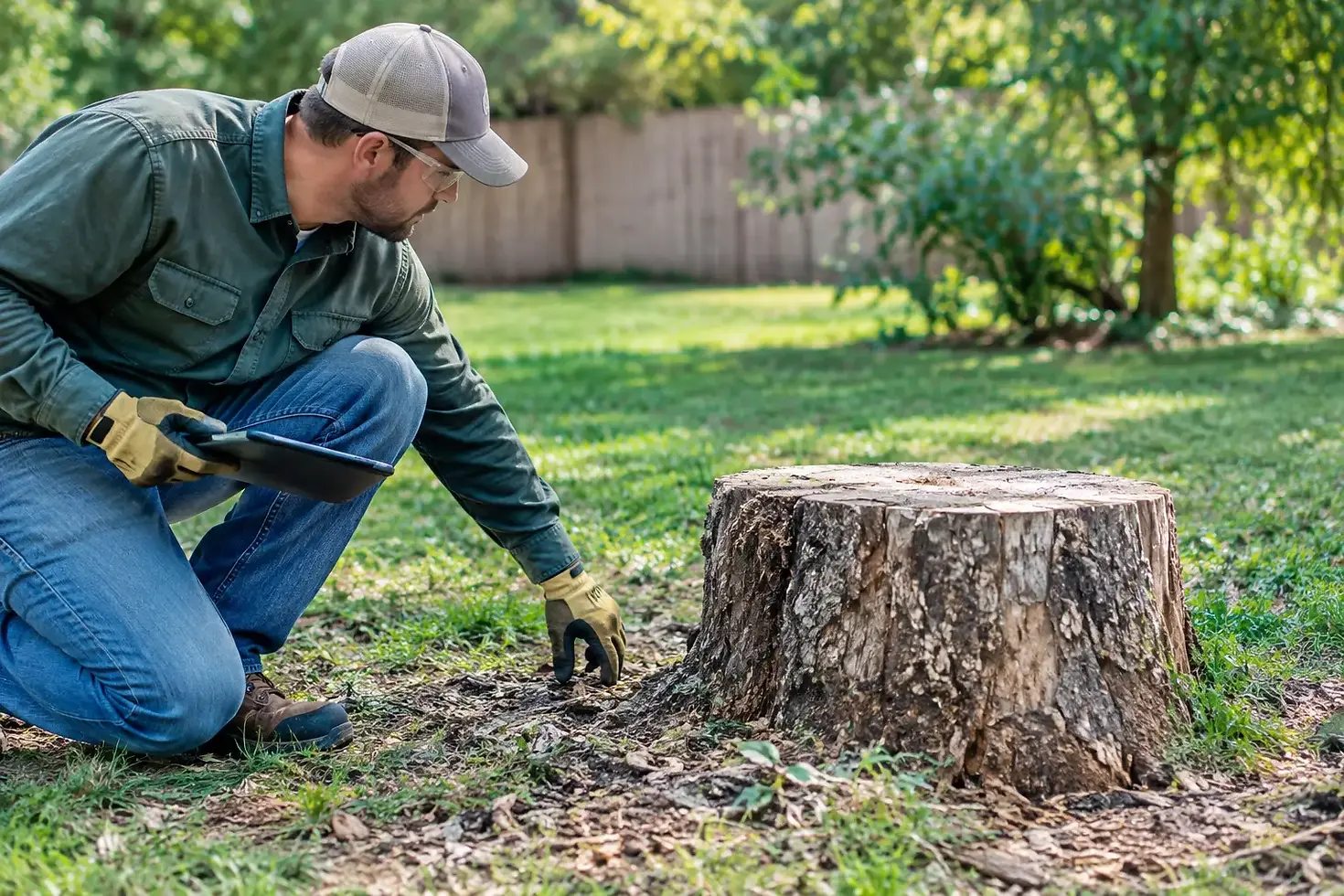
How to Assess Stump Accessibility Before Grinding

A stump can look like a simple job from the kitchen window, then turn complicated the moment a grinder has to reach it. Knowing how to assess stump accessibility before scheduling service helps prevent surprises, supports an accurate quote, and gets the work moving faster.
For most residential stump grinding jobs, accessibility comes down to a few practical questions: Can the equipment get from the street or driveway to the stump? Is there enough room to work around it? Are there utilities, landscaping features, or site conditions that need attention first? A quick walk around the yard usually provides the answers.
How to Assess Stump Accessibility Before Grinding
Start at the place where a truck and grinder would reasonably enter the property. Follow the same route all the way to the stump, rather than judging access by how close the stump looks to the driveway. A stump 30 feet from the driveway can be easier to handle than one 10 feet away behind a narrow gate, a retaining wall, or a row of shrubs.
Take a few clear photos from different angles while you do this. One photo showing the access route, one showing the stump and its surroundings, and one showing any tight spot or obstacle can make a photo-based estimate much more reliable.
Measure gates and narrow passages
Gate width is often the first make-or-break detail. Measure the narrowest point along the route, not just the opening of the gate itself. Fence posts, latches, low-hanging branches, air-conditioning units, and stacked materials can all reduce usable clearance.
Do not assume a standard backyard gate provides enough room. Stump grinders come in different sizes, and the right machine for a large hardwood stump may need more access than a small gate allows. If access is tight, a stump grinding professional can determine whether a compact machine is appropriate, whether part of a fence panel should be temporarily removed, or whether another approach makes more sense.
Also look up. Low branches, deck overhangs, and wires can limit a machine's path even when the ground-level opening seems wide enough. Never attempt to move or work near a service wire yourself. Point it out during the estimate instead.
Check the ground between the street and stump
A clear path is not always a usable path. Walk the route and look for soft ground, steep slopes, uneven stone walls, steps, loose gravel, muddy areas, and drainage ditches. Southern New Hampshire yards can change quickly with spring thaw or heavy rain, so ground conditions matter as much as the distance.
Firm, level ground is best for moving equipment safely. A mild slope is usually manageable, but steep grades, side hills, or wet ground may affect which equipment can be used and when the job should be scheduled. Waiting for the yard to dry out can be the better call if it avoids ruts or damage to turf.
Be honest about seasonal conditions when requesting a quote. If the access route is usually solid but currently muddy, say so. That gives the contractor a chance to plan around the situation rather than arriving with an inaccurate picture of the site.
Look Closely at the Space Around the Stump
Getting to the stump is only half the job. The grinder needs working room around it. Check whether the stump sits beside a house, fence, shed, deck, patio, pool edge, garden bed, stonework, or parked vehicle. Nearby structures do not automatically prevent grinding, but they can affect the equipment choice and the amount of care required.
A stump positioned in open lawn is straightforward. One growing next to a fence corner or within a landscaped bed may take more time because the operator needs to protect surrounding surfaces and work within a tighter area. Roots that run beneath walkways, pavers, or walls also deserve a closer look. Grinding removes the visible stump and can address surface roots where practical, but it does not mean excavating every root across the yard.
Move portable items before the appointment when possible. Patio furniture, planters, lawn decorations, hoses, toys, firewood, and loose garden edging are easy to clear and give the crew more room to work. Leave heavy or built-in features alone unless you have discussed them beforehand.
Consider stump size, height, and condition
The stump itself affects access and pricing. Estimate its width at ground level, where the roots flare out, not only across the cut surface. A stump that looks modest on top may be much wider at the base.
Note whether it is freshly cut, old and decayed, unusually tall, split, or surrounded by exposed roots. Large species such as oak, maple, and pine can have substantial root systems. A tall stump is not necessarily a problem, but it may require additional cutting or handling before grinding.
If the tree was removed after a storm, look for embedded metal. Old fence wire, nails, lag bolts, clothesline hardware, and treehouse fasteners can damage grinding teeth and create a safety issue. Mention anything you know about the tree's history, especially if it once held a swing, sign, or fence attachment.
Identify Utilities Before Any Grinding Begins
Underground utilities are not something to guess about. Gas, electric, water, sewer, cable, internet, irrigation, septic components, invisible pet fencing, and landscape lighting may all be present near a stump or along the equipment route.
Call 811 before digging or grinding work that could affect buried utility lines. The utility-marking process is a basic safety step, and it is especially worthwhile if the stump is near the street, driveway, utility pedestal, or house service area. Keep in mind that public utility marking may not identify privately installed lines, such as irrigation, propane lines beyond the meter, or lighting wire. Homeowners should identify those systems and share the details before work begins.
Septic systems need special attention. If a stump is near a septic tank, leach field, distribution box, or known septic line, let the contractor know. Heavy equipment should not be routed over sensitive areas simply because it is the shortest path.
Think About Cleanup and Where the Grindings Will Go
Grinding a stump produces wood chips and soil. In many cases, the grindings can remain on site for use as mulch or to help fill the ground-out area. That is convenient, but it is worth deciding in advance whether you want them spread nearby, left in a pile, or removed.
Access affects cleanup, too. If the stump is behind a narrow passage or on a steep backyard slope, removing material may take more labor than a stump beside the driveway. Be clear about your expectations so the quote reflects the finish you want. A clean result should mean more than making the stump disappear. It should leave the area ready for grass seed, a garden project, or the next step in your landscaping plan.
What to Send When Requesting a Quote
Clear information saves time. Along with photos, provide the number of stumps, approximate width of each stump, the nearest access point, and the narrowest gate or passage measurement. Mention slopes, soft ground, fences, utility concerns, septic areas, and obstacles beside the stump.
A short note can be enough: “One 24-inch maple stump in the fenced backyard. The gate opening is 42 inches. Access is level from the driveway, but the stump is two feet from a vinyl fence.” That gives a stump grinding specialist far more to work with than a single close-up photo.
If you are unsure about a detail, say that too. A dependable contractor would rather inspect a questionable access point than promise a price or arrival plan based on assumptions.
When Tight Access Is Still Worth Addressing
A hard-to-reach stump is not automatically a stump that must stay put. Homeowners often put off removal because the stump sits behind a fence, close to a deck, or at the edge of a wooded yard. Sometimes the solution is a smaller machine. Other times, minor preparation such as clearing a path or temporarily removing a fence panel makes the job practical.
The trade-off is usually time and labor. Tight access can increase the cost compared with an open-lawn stump, but leaving the stump may continue to interfere with mowing, landscaping, and yard use for years. Getting a job-specific assessment lets you compare the real options instead of assuming removal is out of reach.
Before you book, walk the route, take honest photos, measure the tight spots, and flag utilities or delicate landscaping. That small bit of preparation helps Level Ground Stump Grinding arrive ready to do what we promise: grind 'em til you can't find 'em.


Comments