


How Long Does Stump Grinding Take at Your Home?
- Massimo Hagen

- Jul 13
- 5 min read
Updated: Aug 4
That old stump has probably taken more of your time than it deserves. It catches the mower, gets in the way of a new garden bed, and makes an otherwise clean yard look unfinished. So, how long does stump grinding take? For most single residential stumps, the actual grinding work often takes 30 minutes to two hours. Smaller, accessible stumps can be handled faster, while large, old, or hard-to-reach stumps may take longer.
The good news is that stump grinding is usually a one-visit job. A professional crew arrives with the right machine, grinds the stump below ground level, cleans up the work area, and leaves you with usable space instead of a yard obstacle. The exact timeline depends less on the clock and more on the stump, the site, and what is buried nearby.
How Long Does Stump Grinding Take for Most Homes?
A small stump from an ornamental tree or a young tree can sometimes be ground in 15 to 30 minutes once the equipment is in position. A medium-sized stump, such as one left from a maple, birch, or similar backyard tree, commonly takes 45 minutes to an hour and a half. Large hardwood stumps can require several hours, particularly if the root flare is wide or the tree was cut close to the ground.
Those are working-time estimates, not just the time the grinding wheel is spinning. A complete service call also includes getting equipment safely into place, checking the work area, managing wood chips, and cleaning up before leaving. Homeowners should plan for a half-day window for most standard appointments, even when the actual stump is gone much sooner.
Multiple stumps do not always mean the job takes several separate appointments. If stumps are in the same yard and the machine can move easily between them, the work becomes more efficient after setup. Five small stumps in an open backyard may take less time than one oversized stump tucked behind a fence or beside a retaining wall.
Stump Diameter Makes the Biggest Difference
Diameter is one of the clearest predictors of grinding time. A 10-inch stump is a very different job from a 36-inch stump. The grinder must work across the full width of the stump and down to the planned depth, usually several inches below grade so the area can be covered with soil, seed, mulch, or landscaping.
Tree species matters too. Pine and other softer woods generally grind more quickly than dense hardwoods. Oak, hickory, and older maple stumps can take more time because the wood is tougher and the root system may be broad. A decaying stump is not automatically a quick job either. Rot can make sections easier to grind, but old stumps often have hidden rocks, dirt, or root flare that slows the process.
Access Can Speed Up or Slow Down the Job
A grinder works best when it can reach the stump without unnecessary obstacles. A stump near the driveway or in an open side yard is usually straightforward. One behind a narrow gate, on a steep slope, or surrounded by landscaping needs more planning.
Access challenges do not mean the stump cannot be removed. They simply affect the equipment choice and the amount of labor involved. Tight spaces, gates, steps, decorative stone, fences, and nearby structures all need to be considered before work begins. A photo-based estimate is useful because it lets the stump grinding specialist see the approach, not just the stump itself.
Ground conditions can also affect timing. After heavy rain, soft ground may limit where equipment can travel without leaving ruts. Frozen ground, snow cover, or a slope can add time as well. In Southern New Hampshire, changing weather and rocky soil are part of the reality of outdoor work, so a reliable contractor will assess the conditions rather than rush a machine into a yard it could damage.
What Happens During a Stump Grinding Appointment?
The work starts with a quick review of the stump, access route, and nearby features. The operator confirms the scope of work and identifies anything that needs protection, such as a fence, garden border, sprinkler head, patio edge, or nearby plantings.
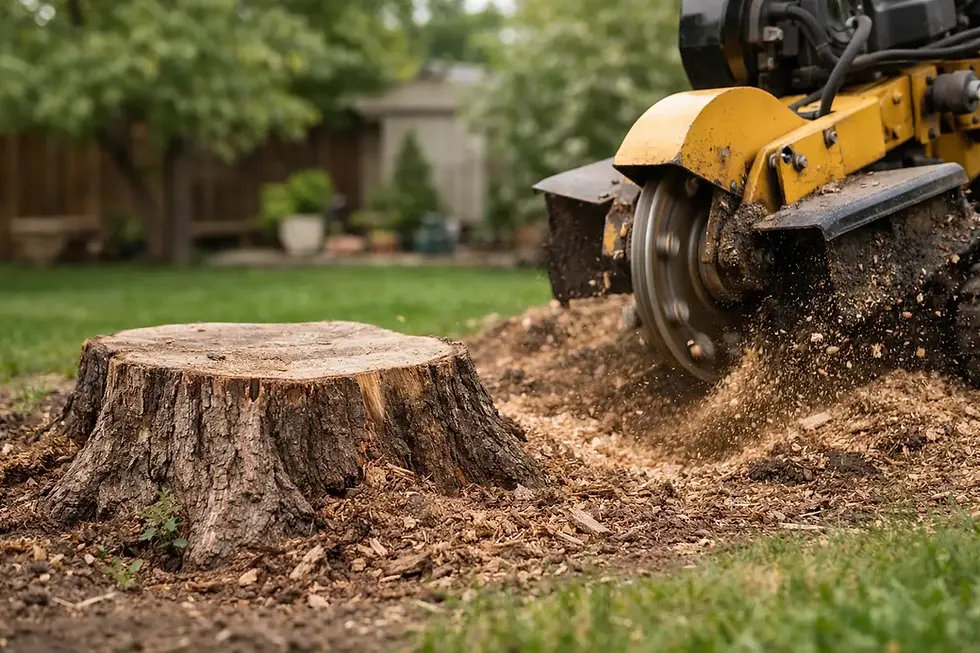
The grinder is then positioned over the stump. Its cutting wheel chips away at the wood in controlled passes, reducing the stump and major surface roots below ground level. Wood chips are created during this process. Depending on the job agreement, those chips may be left on site for mulch, spread into the hole, or moved into a neat pile for the homeowner to use or remove.
Once the stump is ground, the crew checks the area for visible roots and remaining high spots, then tidies the work zone. The result is not an instant patch of lawn, because grass still needs time to grow, but it is a clean, level-ready area without the raised stump that was blocking your plans.
Stump grinding is different from full excavation. Grinding removes the visible stump and grinds down the major root structure around it. Deep roots farther from the stump are typically left to break down naturally underground. For most residential yards, that is the practical choice because it avoids tearing up a much larger section of lawn.
Utility Marking Is Part of the Timeline
Before grinding, underground utilities must be addressed. Gas, electric, water, sewer, cable, and irrigation lines may be present even if they are not obvious from the surface. In many cases, a utility locate request needs to be completed before work can safely proceed.
This is often the part that takes days, not the grinding itself. Utility marking schedules vary, and weather or holiday periods can affect response times. If your stump is near a utility box, service line, street, driveway, or known buried line, mention that when requesting an estimate. Clear information upfront helps prevent delays and protects your property.
Private lines, including some irrigation systems, invisible dog fences, propane lines, and landscape wiring, may not be marked by public utility services. Homeowners should point out anything they know is buried in the area. A few minutes of communication can save a major repair later.
How to Help the Job Go Faster
You do not need to do much to prepare for stump grinding, but a little access planning helps. Clear toys, furniture, planters, hoses, and loose yard items from the route to the stump. If a gate needs to be unlocked or a dog needs to be indoors, take care of that before the appointment window.
It also helps to identify any private underground features and let the crew know about them. If you want the wood chips handled a specific way, mention it before work starts. Some homeowners want them for mulch around trees and shrubs. Others want the area left ready for topsoil and grass seed.
Avoid cutting the stump lower on your own unless advised to do so. A stump cut extremely close to the ground can be harder for a grinder to work with safely and efficiently. Leaving a manageable amount of stump above grade gives the machine something solid to engage.
When a Fast Job Is Still Worth Doing Right
The quickest stump grinding job is not always the best one if the operator skips site checks, utility safety, or cleanup. A professional should work efficiently without cutting corners around your lawn, nearby structures, or buried lines. That is what turns stump removal from another yard headache into a finished-looking improvement.
At Level Ground Stump Grinding, the goal is simple: remove the eyesore, protect the property, and leave the space looking better than when we arrived. Whether your stump takes 30 minutes or a few hours, the value is in getting your yard back. We grind 'em til you can't find 'em!


Comments