


How to Remove Surface Roots Without Hurting Trees
- Massimo Hagen
- Aug 9
- 5 min read
A lawn mower catches a raised root, the grass will not grow over it, and suddenly the obvious question is how to remove surface roots. The catch is that roots are not just in the way. On a living tree, they provide stability, move water and nutrients, and often sit close to the surface for a reason. Cutting the wrong roots can create a bigger problem than the one you started with.
The right approach depends on whether the roots belong to a healthy, living tree or to a stump left after a tree was removed. Those are two very different jobs. One calls for caution and sometimes an arborist’s opinion. The other may be a good candidate for professional stump grinding.
Why tree roots rise to the surface
Most tree roots grow in the upper 12 to 18 inches of soil, where oxygen, moisture, and nutrients are easiest to find. In compacted soil, heavy clay, poorly drained ground, or thin soil over ledge, roots may stay even closer to the surface. That is common in parts of Southern New Hampshire, where rocky ground and mature yards can make underground conditions less than ideal.
Some trees are also more likely to show surface roots than others. Maples, birches, beeches, willows, and poplars are frequent offenders. As a tree matures, its root system expands beyond the canopy and may gradually lift the lawn above it.
A surface root does not automatically mean something is wrong with the tree. It may simply be doing what healthy, established trees do. The goal is not always to remove the root. Often, the safer solution is to work around it.
How to remove surface roots from a living tree safely
Start with this rule: do not cut a major root just because it is visible. Large roots near the trunk are usually structural roots. Removing one can weaken the tree, reduce its ability to take up water, and increase the chance of decline or storm damage.
Before you cut anything, look at the root’s size and location. A root wider than about 2 inches deserves extra caution, especially if it is within a few feet of the trunk. Cutting several smaller roots in one area can also be harmful, even if each cut seems minor on its own.
If a small, shallow root is creating a mowing issue farther from the trunk, careful root pruning may be possible. Expose the root gently with a hand trowel so you can see its size and direction. Use clean, sharp pruning tools to make one smooth cut. Do not rip, tear, or repeatedly chop at the root with an axe or shovel.
Keep the cut as far from the trunk as practical, and avoid removing more than a small portion of the root system at one time. There is no universal safe distance because tree species, age, health, soil, and root layout all matter. When a mature tree is involved, getting a qualified arborist to assess the root is money well spent.
After pruning, replace the soil and keep the area watered during dry weather. Watch the tree over the following months for thinning leaves, dieback in the canopy, or unusual stress. Root damage may not show up right away.
Do not bury exposed roots under deep soil
It is tempting to cover surface roots with several inches of topsoil and seed the area. That can smother the roots by reducing oxygen around them. A thin layer of quality topsoil may work in limited situations, but piling soil against the trunk or over the root flare can lead to rot and long-term decline.
A better option is often to create a mulched bed around the tree. Use 2 to 3 inches of mulch, keep it pulled back from the trunk, and let the roots remain protected instead of fighting to grow grass where grass does not want to grow. A wider mulch ring also keeps mower blades and string trimmers away from the tree’s base.
When not to cut surface roots
Some situations call for a firm no. Do not cut roots that appear to be holding a tree upright, roots close to the trunk, or roots on the side of a tree that faces prevailing winds or a slope. Avoid root cutting on a tree that is already stressed, leaning, damaged, recently transplanted, or showing signs of disease.
Be especially careful near driveways, patios, retaining walls, septic systems, and utility lines. Roots can be tangled around infrastructure, and digging or cutting without knowing what is below can create an expensive repair. Call for utility marking before any digging or grinding work in an area where buried lines may be present.
If the root has lifted a walkway or created a trip hazard, root removal is still not always the best answer. Depending on the situation, resetting the walkway, rerouting a path, or changing the landscape bed may preserve both the tree and the usable space around it.
Removing roots from an old stump is different
Once a tree has been removed, the remaining stump and visible roots no longer serve a living tree. They can still interfere with mowing, landscaping, fencing, gardens, and new lawn work. This is where stump grinding is usually the practical solution.
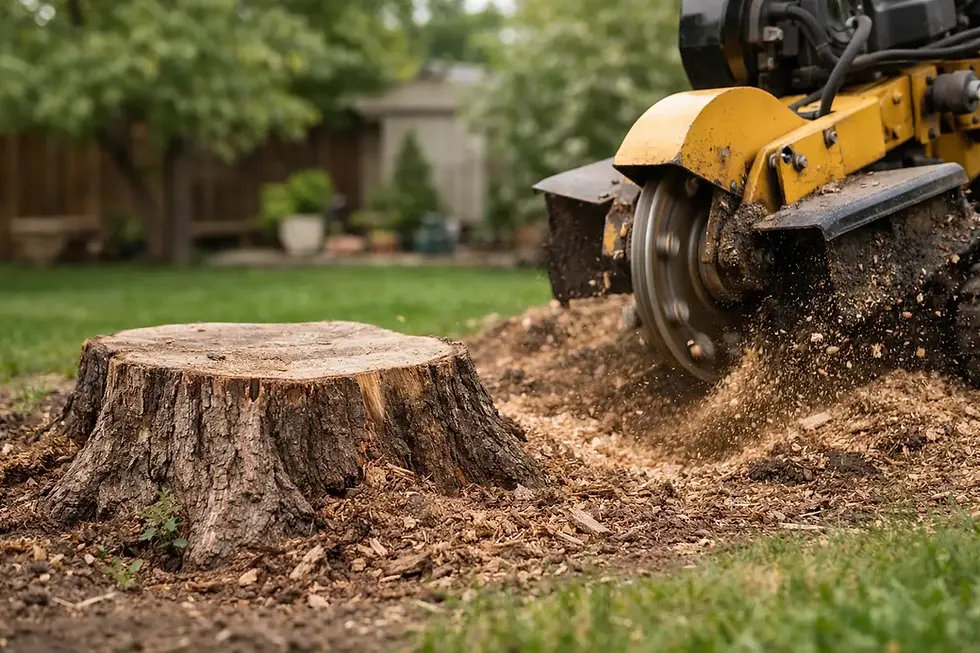
A stump grinder breaks down the stump below ground level and handles the main root flare around it. That removes the hard, visible portion that causes the biggest yard obstacle. Smaller underground roots are typically left to decay naturally over time, which is usually preferable to excavating the entire yard.
Trying to pull out every root by hand can mean a lot of digging, torn-up turf, and unnecessary damage to nearby landscaping. Full excavation may make sense when you are installing a foundation, pool, utility line, or another project that requires a completely clear area. For most residential yards, though, grinding the stump and major surface roots is faster, cleaner, and more affordable.
Level Ground Stump Grinding can assess whether the roots you see are connected to an old stump and explain what can be ground safely. The goal is simple: get rid of the obstacle without turning your yard into a construction site. We grind ’em til you can’t find ’em!
What to expect after stump grinding
Grinding creates a mix of wood chips and soil. That material can be used as mulch in some areas, but it is not ideal as the only material for reseeding grass because it settles as the remaining wood breaks down. For a clean lawn repair, remove or spread out excess grindings, add screened topsoil, level the area, and seed or sod as needed.
It is also normal for a few small roots to remain underground. They will decay over time. If you plan to plant a new tree in the same spot, move the new planting hole several feet away from the old stump location whenever possible. Fresh wood debris and old roots can make establishment harder for a young tree.
Safer alternatives to root removal
Before cutting a living tree’s roots, consider whether the problem can be managed instead. A mulched planting bed works well around many mature trees. For a minor mower issue, adjusting the lawn edge around the root may be enough. If roots are raising a small section of pavers, a hardscape contractor may be able to reset that section without harming the tree.
Removing a tree may be the right call when it is dead, hazardous, severely declining, or poorly placed for the property. Once the tree is down, do not leave the stump and surface roots as the next headache. Grinding them out gives you a safer, cleaner area that is easier to mow, landscape, and enjoy.
The best result is not always the deepest cut. If the roots belong to a tree you want to keep, protect the tree and redesign the space around it when you can. If they belong to an old stump, clearing that obstacle can be the straightforward fresh start your yard needs.


Comments