


How Stump Grinding Works in Your Yard
- Massimo Hagen
- Jun 9
- 6 min read
Updated: Aug 4
That old stump usually stops being "just part of the yard" the moment you hit it with a mower, trip over it, or try to plan a new garden bed around it. If you have been wondering how stump grinding works, the short answer is simple: a specialized machine grinds the stump down below ground level so the area is safer, cleaner, and easier to use.
For most homeowners, that is the part that matters. You want the stump gone, the yard looking better, and the job handled without damage or a big mess. The details are worth knowing, though, because they explain why stump grinding is usually faster and less disruptive than trying to dig a stump out by hand.
How stump grinding works from start to finish
Stump grinding is not the same thing as pulling a stump out of the ground with all its roots attached. Full extraction is a much more invasive process. Grinding focuses on reducing the visible stump and the upper root flare into wood chips using a powerful cutting wheel.
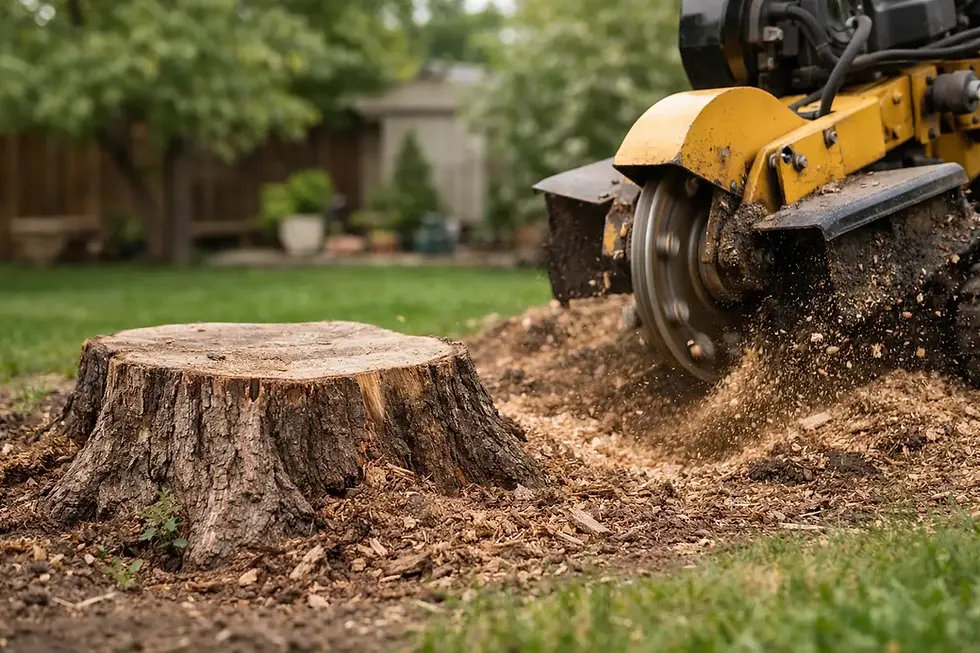
The machine itself has a rotating wheel fitted with tough cutting teeth. As that wheel spins, the operator moves it back and forth across the stump, shaving away wood in layers. Instead of yanking the stump upward, the grinder chips it down gradually. That is what makes the process more controlled and usually much easier on the surrounding yard.
In a typical job, the operator first checks the stump size, location, and access to the area. A stump in an open front yard is different from one tucked beside a fence, near a shed, or surrounded by landscaping. Good access helps the job go faster, but even tighter areas can often be handled with the right machine.
Before any grinding starts, utility safety matters. Underground lines need to be considered any time work is happening below the surface. A professional service will make sure the site is handled properly before the stump is ground below grade.
Once the area is ready, the machine is positioned next to the stump. The cutting wheel starts above the stump surface and works its way down. The operator sweeps the wheel side to side, removing a little wood at a time. That motion keeps the grind even and controlled. As the stump is chewed away, it turns into a pile of mulch-like wood chips.
Most stumps are ground several inches below ground level. That depth is what allows the area to be covered, leveled, and put back into use. If a homeowner plans to plant grass, spread topsoil, or improve the look of the area, grinding below the surface is what makes that possible.
What happens below the surface
A lot of people assume a stump is just the part they can see. In reality, the base of the tree widens at the ground line, and large roots often spread outward from that point. That is why a stump can look modest above ground but still take time to remove properly.
When people ask how stump grinding works, they are often really asking whether the roots disappear too. The honest answer is that it depends on which roots you mean. The grinder handles the main stump and the upper portion of the major surface roots near it. It does not usually chase every root running deep or far across the yard.
For most residential properties, that is not a problem. Those deeper roots typically break down naturally over time. What homeowners usually want removed is the visible stump and the root flare that interferes with mowing, landscaping, or appearance. Grinding solves that issue without tearing up a large section of the lawn.
This is one of the biggest trade-offs between grinding and full excavation. Excavation removes more of the root system, but it also means more disturbance, more labor, and usually more repair work afterward. Grinding is often the practical choice because it gets rid of the problem you actually see and deal with every week.
Why stump grinding is usually the better fit for homeowners
If your main goal is to reclaim the space and improve the look of the yard, stump grinding is hard to beat. It is efficient, targeted, and far less disruptive than digging out the entire root ball.
That matters in real residential settings. Most homeowners are not dealing with a raw building lot where major excavation is already happening. They are dealing with an established lawn, a driveway edge, a fence line, or a backyard where kids and pets play. In that kind of space, a service that removes the eyesore without wrecking the surrounding area makes more sense.
Grinding also helps with everyday annoyances. A leftover stump becomes an obstacle when mowing. It can attract insects, collect weeds, and make the yard look unfinished long after a tree has been removed. Once the stump is ground down, the area feels usable again.
There is also the question of safety. Old stumps create trip hazards, especially in side yards, play areas, and spots that get less attention during routine yard work. Removing that obstacle is not just about appearance. It makes the space easier and safer to move through.
What to expect on the day of service
For a homeowner, the process is usually more straightforward than expected. The biggest factors are access, stump size, and how close the stump is to structures or hardscaping.
When the crew arrives, the work area should be clear of toys, planters, lawn decor, or anything else near the stump. From there, the operator brings in the grinder, sets up safely, and begins cutting the stump down in passes. The machine is loud and throws chips during operation, which is why controlled setup and proper handling matter.
The actual grinding time can be surprisingly short for many residential stumps, though larger or older stumps take longer. Multi-stump jobs also vary depending on spacing and size. A good service will give you a clear idea of what to expect rather than guessing.
After the grinding is finished, you are left with a mound of wood chips mixed with some soil. Some homeowners keep those chips for mulch. Others prefer cleanup and removal so the area is ready for topsoil and seed. Either option can work. What matters is knowing the plan ahead of time.
If the goal is a smooth finished look, the area can be backfilled and leveled after grinding. That is the step that helps the yard look complete instead of just improved. It is also why hiring a specialist matters. The difference between "the stump is gone" and "you can’t even tell it was there" often comes down to how the job is finished.
Common questions homeowners have
One of the most common concerns is whether the tree can grow back. That depends on the tree species and how much live root material remains, but grinding the stump down significantly reduces the chance of regrowth from the main stump area. Some species are more aggressive than others, which is why local experience helps.
Another question is whether stump grinding damages the lawn. Compared with full removal, it is much easier on the yard. There can still be minor surface impact from moving equipment in and out, especially if the ground is soft, but it is generally a much cleaner process than excavation.
People also ask if they can do it themselves. Technically, stump grinders can be rented, but this is one of those jobs that looks simpler than it is. The equipment is powerful, the teeth can catch unpredictably, and utility awareness is a serious issue. For most homeowners, hiring an insured professional is the safer and more cost-effective route.
When stump grinding makes the most sense
Stump grinding is the right fit when you want the stump out of sight, the yard looking better, and the area ready for normal use again. It is especially useful after tree removal, before landscaping upgrades, or anytime a stump has become a nuisance.
It also makes sense when speed and convenience matter. Homeowners usually do not want a drawn-out project for a single stump or a few scattered stumps around the property. They want someone to show up, handle the work professionally, and leave the place looking noticeably better. That is exactly why specialists like Level Ground Stump Grinding stay focused on this one job and do it well.
A stump does not have to be huge to be a problem. Sometimes the smallest leftover stump is the one that catches your mower wheel every week and reminds you the yard still feels unfinished. Once it is ground down properly, the whole space tends to feel cleaner, safer, and easier to enjoy - which is really the point.


Comments